

Getting started with Prestashop, part 1
Thinking of trying your hand at online retail? This series will help you understand how to organize it and how to start your own e-commerce adventure. If you have been thinking about trying your hand at online retail and would like to know how it can be organized, this series will help you understand how to start your own adventure in this field.
This post gives an introduction to e-commerce, a short look at the solutions on offer and, as the title suggests, an introduction to Prestashop
The e-commerce market in Poland 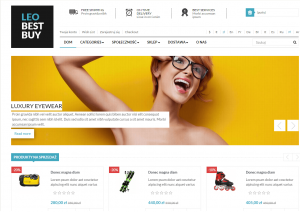 has been growing ever since it appeared, but it is in recent years that the growth trend has been strongest: in 2016 growth of about 30% compared with 2015 is forecast, i.e. ~ 38 billion PLN.
So if, for example, you already run a business in the so-called “offline” world and are waiting for the right moment to trade online as well, or you sell on the side, for instance on auction/sales portals, and are wondering whether it makes sense to do it professionally – right now is the best time. Of course, there are countless forms of selling online – I hope to cover them in more detail in one of the next posts.
Also for people looking for an alternative to a traditional job, opening your own online store may be just the thing.
Myths are often repeated that the online market is already “taken” by the big players. That is not true; many books have been written on the subject and it will probably be a topic for a separate post, but it is easy to imagine that the methods and solutions available to new and small players are out of reach for big brands because of, for example, their established procedures.
If you want to open your own business online, you can do so in many ways. One of them is to go to a software development company, but that is the most expensive and slowest way. Another is, for example, mass selling on Allegro, but it has its downsides, because you are not working for your own brand, but for the one you sell on. When someone asks your customer where they bought “this” product, they will answer that it was on Allegro, not from you. That is why the best solution is to operate under your own name. Even better if the store already has ready-made, bug-free software and a tested, usable interface that customers know how to navigate. I mean, of course, PrestaShop stores. In the next post we will get more specific about Presta; topics will include the available features, extensibility and starting the installation of your first store.
has been growing ever since it appeared, but it is in recent years that the growth trend has been strongest: in 2016 growth of about 30% compared with 2015 is forecast, i.e. ~ 38 billion PLN.
So if, for example, you already run a business in the so-called “offline” world and are waiting for the right moment to trade online as well, or you sell on the side, for instance on auction/sales portals, and are wondering whether it makes sense to do it professionally – right now is the best time. Of course, there are countless forms of selling online – I hope to cover them in more detail in one of the next posts.
Also for people looking for an alternative to a traditional job, opening your own online store may be just the thing.
Myths are often repeated that the online market is already “taken” by the big players. That is not true; many books have been written on the subject and it will probably be a topic for a separate post, but it is easy to imagine that the methods and solutions available to new and small players are out of reach for big brands because of, for example, their established procedures.
If you want to open your own business online, you can do so in many ways. One of them is to go to a software development company, but that is the most expensive and slowest way. Another is, for example, mass selling on Allegro, but it has its downsides, because you are not working for your own brand, but for the one you sell on. When someone asks your customer where they bought “this” product, they will answer that it was on Allegro, not from you. That is why the best solution is to operate under your own name. Even better if the store already has ready-made, bug-free software and a tested, usable interface that customers know how to navigate. I mean, of course, PrestaShop stores. In the next post we will get more specific about Presta; topics will include the available features, extensibility and starting the installation of your first store.
has been growing ever since it appeared, but it is in recent years that the growth trend has been strongest: in 2016 growth of about 30% compared with 2015 is forecast, i.e. ~ 38 billion PLN.
So if, for example, you already run a business in the so-called “offline” world and are waiting for the right moment to trade online as well, or you sell on the side, for instance on auction/sales portals, and are wondering whether it makes sense to do it professionally – right now is the best time. Of course, there are countless forms of selling online – I hope to cover them in more detail in one of the next posts.
Also for people looking for an alternative to a traditional job, opening your own online store may be just the thing.
Myths are often repeated that the online market is already “taken” by the big players. That is not true; many books have been written on the subject and it will probably be a topic for a separate post, but it is easy to imagine that the methods and solutions available to new and small players are out of reach for big brands because of, for example, their established procedures.
If you want to open your own business online, you can do so in many ways. One of them is to go to a software development company, but that is the most expensive and slowest way. Another is, for example, mass selling on Allegro, but it has its downsides, because you are not working for your own brand, but for the one you sell on. When someone asks your customer where they bought “this” product, they will answer that it was on Allegro, not from you. That is why the best solution is to operate under your own name. Even better if the store already has ready-made, bug-free software and a tested, usable interface that customers know how to navigate. I mean, of course, PrestaShop stores. In the next post we will get more specific about Presta; topics will include the available features, extensibility and starting the installation of your first store.
Get notified about new articles
Subscribe by e-mail or turn on browser notifications — we only send new blog posts, nothing else.




Comments
No comment at this time!
Leave your comment