

Lean canvas: a business plan for an online store
Before starting a business, people usually have many doubts. Lean canvas is a tool anyone can apply to their idea to check whether it has a chance to work.  Lean canvas
Before starting a business, people usually have many doubts at the outset. There are many tools and methods that can help, more or less, in making this decision. The best way is always to consult someone who already runs such a business or a similar one. This is not always possible, but fortunately there is a method that anyone can apply to their idea to find out whether it has a chance to work. That method is lean canvas.
A tool that is part of the “lean” philosophy, most often used to validate startups with a non-standard or entirely new business model. In this post I will try to describe the tool as applied to a business that is an online store, thereby starting a whole series that explains each of the fields to fill in, one by one.
The idea behind the creation of this tool was the inefficiency of classic business plans, which had grown to monstrous sizes, containing unnecessary data and therefore ceasing to do their job. A lean canvas itself should take up one page and contain only the key elements of the business, without details that are unnecessary at this stage. All the fields are numbered and each one sits in its proper place.
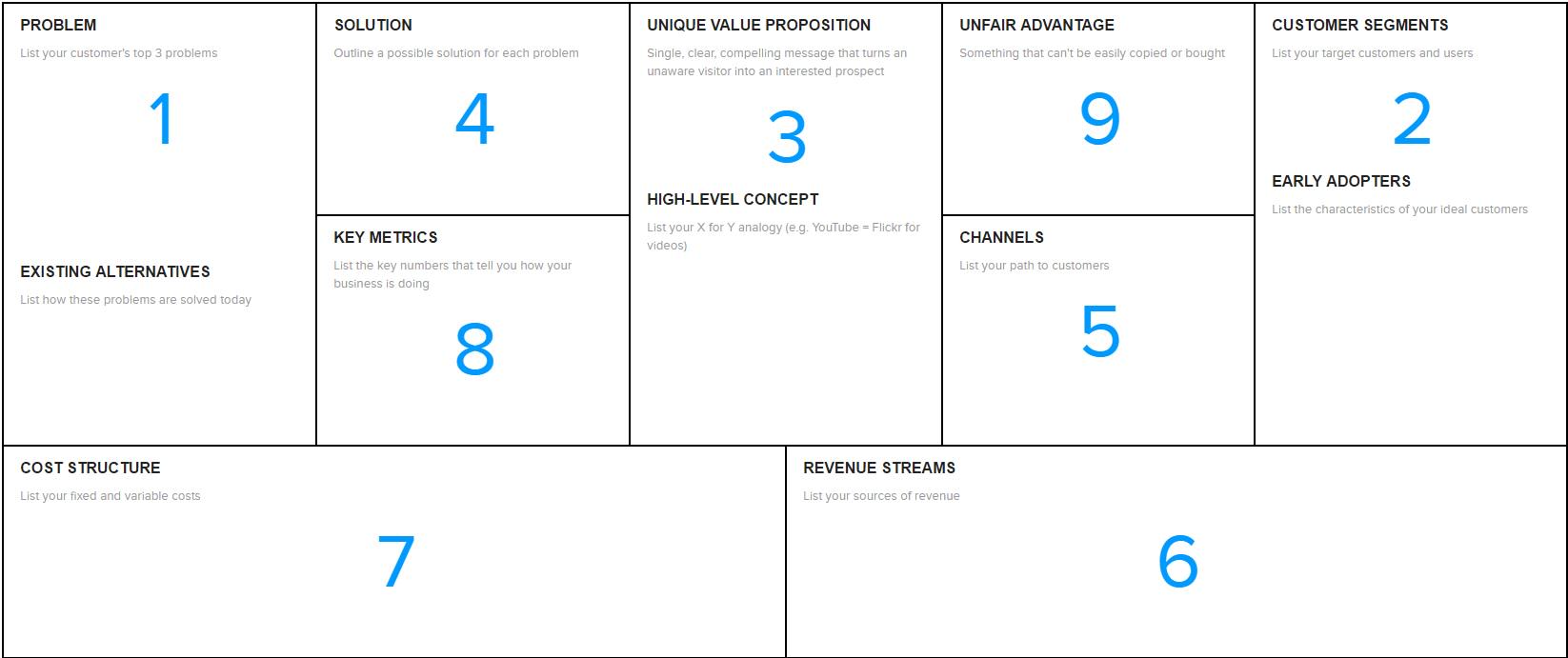
Going in order, field number 1 is the “problem” or “need” that our store solves or satisfies. You should list at most three such things, but one is the ideal. Field number 2 is “customers”. Here you should define as precisely as possible the target group to which the product or service is addressed. It is not enough to say whether they will be women or men. The more detailed the description here, the better.
Field number 3 is “value”, that is, what benefit the customer gets from buying a product or service from you in particular. The next field is “solution”, that is, what your plan is for solving the problem from field number “1”. Zone “5” is “advantage” – what you already have, or can have, to gain an advantage over the competition. Area “6” is “revenue” – what the store is to earn money from. List all possible scenarios and ideas, which will be verified later. Block “7” is “costs”. List all possible ones. Not only those of reaching the customer, but also of production or delivering services. The penultimate field is “metrics”. Write down the methods you will use to measure whether the store is growing and, above all, whether it is making money. The last field is “channels” – list all the routes that come to mind by which you can reach customers.
This is only a very brief description of each field. Each of them will get a separate post that explains exactly why it exists.
Lean canvas
Before starting a business, people usually have many doubts at the outset. There are many tools and methods that can help, more or less, in making this decision. The best way is always to consult someone who already runs such a business or a similar one. This is not always possible, but fortunately there is a method that anyone can apply to their idea to find out whether it has a chance to work. That method is lean canvas.
A tool that is part of the “lean” philosophy, most often used to validate startups with a non-standard or entirely new business model. In this post I will try to describe the tool as applied to a business that is an online store, thereby starting a whole series that explains each of the fields to fill in, one by one.
The idea behind the creation of this tool was the inefficiency of classic business plans, which had grown to monstrous sizes, containing unnecessary data and therefore ceasing to do their job. A lean canvas itself should take up one page and contain only the key elements of the business, without details that are unnecessary at this stage. All the fields are numbered and each one sits in its proper place.
Going in order, field number 1 is the “problem” or “need” that our store solves or satisfies. You should list at most three such things, but one is the ideal. Field number 2 is “customers”. Here you should define as precisely as possible the target group to which the product or service is addressed. It is not enough to say whether they will be women or men. The more detailed the description here, the better.
Field number 3 is “value”, that is, what benefit the customer gets from buying a product or service from you in particular. The next field is “solution”, that is, what your plan is for solving the problem from field number “1”. Zone “5” is “advantage” – what you already have, or can have, to gain an advantage over the competition. Area “6” is “revenue” – what the store is to earn money from. List all possible scenarios and ideas, which will be verified later. Block “7” is “costs”. List all possible ones. Not only those of reaching the customer, but also of production or delivering services. The penultimate field is “metrics”. Write down the methods you will use to measure whether the store is growing and, above all, whether it is making money. The last field is “channels” – list all the routes that come to mind by which you can reach customers.
This is only a very brief description of each field. Each of them will get a separate post that explains exactly why it exists.
 Lean canvas
Before starting a business, people usually have many doubts at the outset. There are many tools and methods that can help, more or less, in making this decision. The best way is always to consult someone who already runs such a business or a similar one. This is not always possible, but fortunately there is a method that anyone can apply to their idea to find out whether it has a chance to work. That method is lean canvas.
A tool that is part of the “lean” philosophy, most often used to validate startups with a non-standard or entirely new business model. In this post I will try to describe the tool as applied to a business that is an online store, thereby starting a whole series that explains each of the fields to fill in, one by one.
The idea behind the creation of this tool was the inefficiency of classic business plans, which had grown to monstrous sizes, containing unnecessary data and therefore ceasing to do their job. A lean canvas itself should take up one page and contain only the key elements of the business, without details that are unnecessary at this stage. All the fields are numbered and each one sits in its proper place.
Going in order, field number 1 is the “problem” or “need” that our store solves or satisfies. You should list at most three such things, but one is the ideal. Field number 2 is “customers”. Here you should define as precisely as possible the target group to which the product or service is addressed. It is not enough to say whether they will be women or men. The more detailed the description here, the better.
Field number 3 is “value”, that is, what benefit the customer gets from buying a product or service from you in particular. The next field is “solution”, that is, what your plan is for solving the problem from field number “1”. Zone “5” is “advantage” – what you already have, or can have, to gain an advantage over the competition. Area “6” is “revenue” – what the store is to earn money from. List all possible scenarios and ideas, which will be verified later. Block “7” is “costs”. List all possible ones. Not only those of reaching the customer, but also of production or delivering services. The penultimate field is “metrics”. Write down the methods you will use to measure whether the store is growing and, above all, whether it is making money. The last field is “channels” – list all the routes that come to mind by which you can reach customers.
This is only a very brief description of each field. Each of them will get a separate post that explains exactly why it exists.
Lean canvas
Before starting a business, people usually have many doubts at the outset. There are many tools and methods that can help, more or less, in making this decision. The best way is always to consult someone who already runs such a business or a similar one. This is not always possible, but fortunately there is a method that anyone can apply to their idea to find out whether it has a chance to work. That method is lean canvas.
A tool that is part of the “lean” philosophy, most often used to validate startups with a non-standard or entirely new business model. In this post I will try to describe the tool as applied to a business that is an online store, thereby starting a whole series that explains each of the fields to fill in, one by one.
The idea behind the creation of this tool was the inefficiency of classic business plans, which had grown to monstrous sizes, containing unnecessary data and therefore ceasing to do their job. A lean canvas itself should take up one page and contain only the key elements of the business, without details that are unnecessary at this stage. All the fields are numbered and each one sits in its proper place.
Going in order, field number 1 is the “problem” or “need” that our store solves or satisfies. You should list at most three such things, but one is the ideal. Field number 2 is “customers”. Here you should define as precisely as possible the target group to which the product or service is addressed. It is not enough to say whether they will be women or men. The more detailed the description here, the better.
Field number 3 is “value”, that is, what benefit the customer gets from buying a product or service from you in particular. The next field is “solution”, that is, what your plan is for solving the problem from field number “1”. Zone “5” is “advantage” – what you already have, or can have, to gain an advantage over the competition. Area “6” is “revenue” – what the store is to earn money from. List all possible scenarios and ideas, which will be verified later. Block “7” is “costs”. List all possible ones. Not only those of reaching the customer, but also of production or delivering services. The penultimate field is “metrics”. Write down the methods you will use to measure whether the store is growing and, above all, whether it is making money. The last field is “channels” – list all the routes that come to mind by which you can reach customers.
This is only a very brief description of each field. Each of them will get a separate post that explains exactly why it exists.
Get notified about new articles
Subscribe by e-mail or turn on browser notifications — we only send new blog posts, nothing else.




Comments
No comment at this time!
Leave your comment