

Lean canvas for an online store: the “Customers” field

Once we have defined what we want to solve or satisfy, we need to think about for whom. The next field to describe is customers. Once we have defined what we want to solve or satisfy, we need to think about for whom. That is why the next field to describe is customers.
As already mentioned before, this block is closely tied to the previous one, the first field, “problem”. This is no accident, because our customers are the people who are supposed to have the needs we assume.
In addition, this block is also the place to list which people could be “early adopters” – that is, something like the first users, in our case more the first customers. Those who already use, for example, competitors’ products or solve their problem in a less than ideal way that you want to improve work very well in this role.
For the lean canvas to make sense, customers should be divided into segments. This division should be made as precisely as possible. You can also list more segments here than we initially assume and let the interaction with potential customers verify the choice. It is always better to have too much data here than too little. If our potential customers are, for example, women, simply writing that down will not be precise enough. A much better solution is to define the segment as, for example: young women with a university education, living in big cities and holding a category A driving licence.
The more precise the definition of this group, the better, all the more so because it will also be needed later in field number “5”, Channels – to determine the routes by which a particular group can best be reached.
If at this stage you do not know who the customers are supposed to be, this is also a way to verify your assumptions. You can, for example, propose mutually exclusive groups such as residents of small towns and of big cities. Then, by meeting representatives of such groups, you can refine your assumptions and quite likely a completely new segment will emerge from this.
There is a theory that checks whether the assumed customer group will really be the target one. It says that you should try to sell your product to a representative of the given segment; if they really buy, this confirms that your assumptions are right. The next post covers field number “3”, the Value proposition.
 Lean canvas field number 2 "customers"
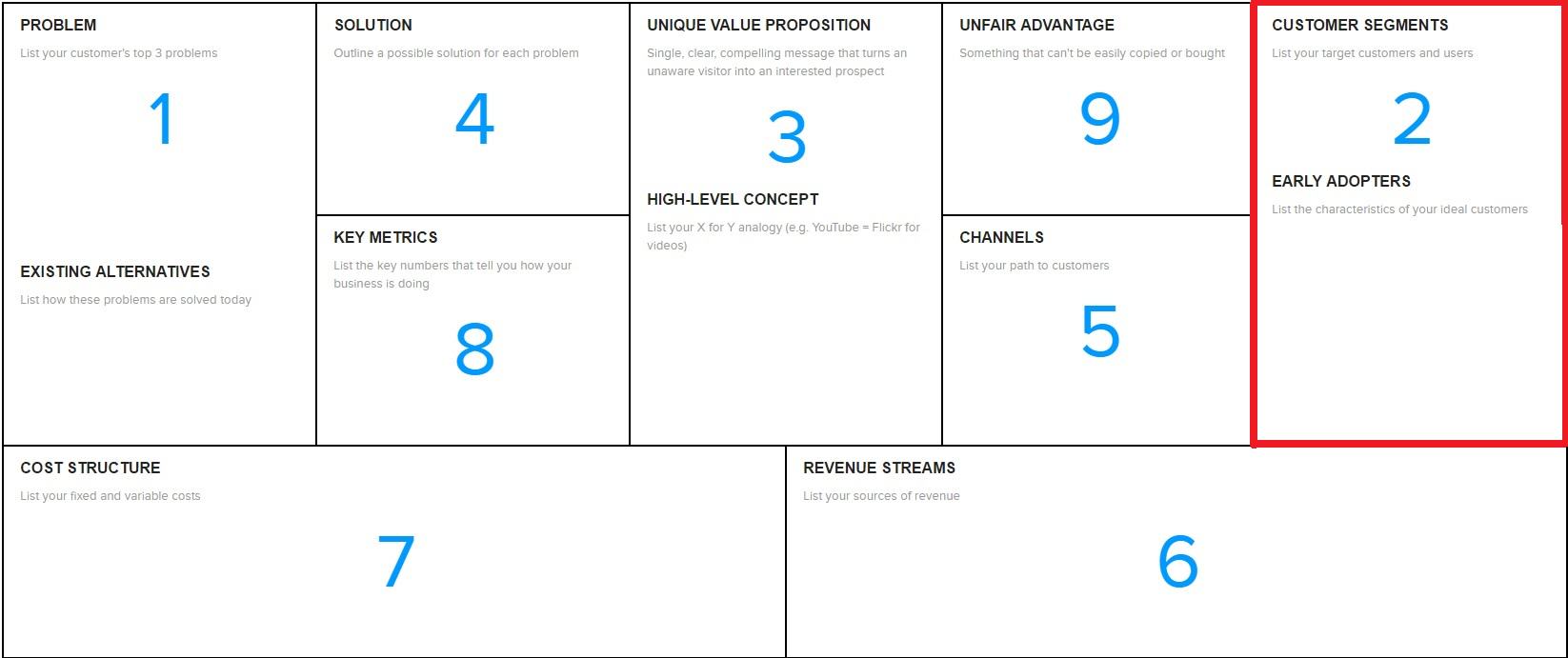 Lean canvas field number 2 "customers"
 Get notified about new articles
Subscribe by e-mail or turn on browser notifications — we only send new blog posts, nothing else.




Comments
No comment at this time!
Leave your comment